
Cairo is a city where five thousand years of history spill out onto the streets, where the roar of traffic gives way, in an instant, to the silence of a two-thousand-year-old church or the hush of a desert plateau guarded by stone lions with the faces of kings.
For any traveler putting together an Egypt itinerary, Cairo is almost always the beating heart of the trip — the place where ancient wonders, living culture, and modern city life collide in a way that no other capital on earth can replicate. Whether you have three days or three weeks, understanding the full range of cairo egypt attractions will help you build a trip that feels complete rather than rushed.
This guide walks through the essential things to see in cairo, from the unmistakable silhouette of the Giza Pyramids to the quiet cloisters of Coptic Cairo, the perfumed lanes of Khan El Khalili, and the desert ruins of Saqqara.
We’ll also look beyond the city limits, covering easy day trips and longer escapes that pair naturally with a Cairo base. Along the way, we’ll answer the question travelers ask more than any other: what is the best time to visit egypt, and how does the weather shape the kind of trip you should plan. By the end, you’ll have a practical framework for choosing among the many egypt vacation packages on offer and building an itinerary that actually matches how you like to travel.
Cairo rewards travelers who mix the big-ticket cairo attractions with slower, more textured experiences — a felucca ride at sunset, a plate of koshary eaten standing at a counter, the muezzin’s call drifting over the rooftops of Islamic Cairo. Let’s start with the sites that draw people to Egypt in the first place: the monuments of the pharaohs.
Top Historical Things to Do in Cairo Egypt
No list of things to do in Egypt’s capital can begin anywhere except with its oldest and most famous residents. Cairo’s historical core spans the Old Kingdom pyramid fields on the desert edge, the treasure-filled halls of its world-class museums, and the Islamic-era citadel that has watched over the city for eight centuries. These are the sites that anchor almost every well-built itinerary, and for good reason — nowhere else on the planet packs this much verified antiquity into such a compact geographic footprint.
Standing in Awe Before the Giza Pyramids and the Great Sphinx
There is a specific, disorienting moment that almost every first-time visitor describes: rounding a corner near the edge of the city and suddenly seeing the Great Pyramid of Khufu rising directly out of the urban sprawl, as if a mountain had simply decided to grow at the end of a residential street. The Giza Plateau is one of the most photographed places on earth, yet nothing quite prepares you for the scale of it in person.
The Great Pyramid alone was built from an estimated 2.3 million limestone blocks, each weighing on average around two and a half tons, stacked with a precision that continues to puzzle engineers more than four and a half thousand years later.
Giza is technically three pyramids in one complex: the Pyramid of Khufu (the largest), the Pyramid of Khafre (which still retains a cap of its original polished limestone casing near the summit), and the smaller Pyramid of Menkaure. Surrounding them are smaller “queens’ pyramids,” the remains of the causeways that once linked the valley temples to the tombs, and the boat pits where dismantled solar barges were discovered, one of which is now displayed at the Giza site itself.
Just below the plateau, facing east toward the rising sun, the Great Sphinx keeps its ancient watch — a limestone lion’s body fused with a royal human head, carved from a single outcrop of bedrock. Its nose has been missing for centuries and its origins are still debated by scholars, but none of that diminishes the effect of standing at its paws and looking up.
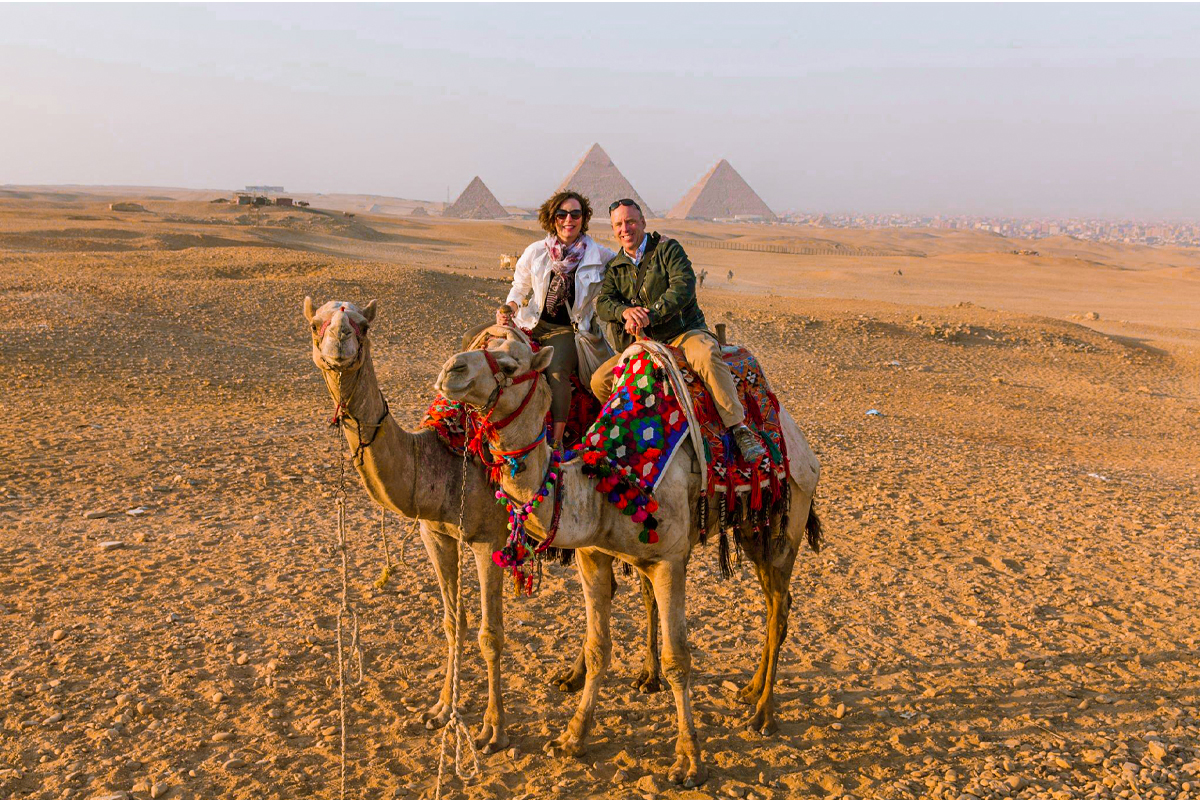
Most travelers pair a Giza morning with a stop at the panorama point for the classic wide-angle photo of all three pyramids together, and many extend the day with a camel or horse ride along the plateau’s edge. Because the site sits on Cairo’s western desert fringe, it’s entirely possible to combine it with other major attractions in a single well-organized day — which is exactly the approach used by structured excursions built around Giza and Egypt’s museums.
Unveiling Pharaonic Royal Treasures at the New Grand Egyptian Museum (GEM)
For more than a century, the treasures of ancient Egypt were scattered across smaller institutions or crammed into the beloved but aging halls of Tahrir Square’s Egyptian Museum.
That changed with the opening of the Grand Egyptian Museum, a purpose-built complex sitting almost within view of the Giza Plateau itself. GEM is now the largest archaeological museum devoted to a single civilization anywhere in the world, and it was designed from the ground up to finally display the full scope of Tutankhamun’s burial goods together in one place for the first time since the tomb was opened in the 1920s.
Walking through GEM feels less like visiting a traditional museum and more like moving through a series of monumental halls, each framed with sightlines back toward the pyramids themselves.
The grand staircase alone is lined with dozens of colossal statues, arranged in rough chronological order so visitors climb through Egyptian history as they ascend toward a final window that frames the pyramids in the distance — a deliberate architectural echo between the museum and the monuments it was built to complement.
The sheer volume of objects on display, from royal chariots to gilded shrines to jewelry that has barely been shown publicly before, makes this one of the most significant new cultural attractions to open anywhere in the world in the last decade. Because of its proximity to Giza, the two sites are almost always visited together, and travelers looking for a single well-paced day that covers both should look at a guided Pyramids of Giza and Grand Egyptian Museum Tour, which is built specifically around combining the pyramid plateau with GEM’s galleries without the logistical guesswork of arranging transport and timed-entry tickets independently.
Discovering the Royal Mummies at the National Museum of Egyptian Civilization (NMEC)
Slightly less crowded than GEM but no less significant, the National Museum of Egyptian Civilization sits in the old Fustat district near Cairo’s original Islamic settlement. NMEC gained international attention in 2021 when Egypt staged the “Pharaohs’ Golden Parade,” a carefully choreographed procession that transferred 22 royal mummies from the old Egyptian Museum to their new home here in specially built vibration-dampened vehicles.
The museum’s Royal Mummies Hall is the main draw, and it’s genuinely unlike anything else in the country. Kings and queens whose names most visitors already know from history books — Ramesses II, Seti I, Hatshepsut, and others — lie in low-lit, climate-controlled cases, their linen wrappings removed just enough over the decades of study to reveal faces, hands, and hair that have survived for over three thousand years.
The presentation is respectful and almost hushed compared to the more bustling energy of GEM or the Giza plateau, and many visitors find it the most emotionally affecting stop on their entire trip.
Beyond the mummies, NMEC’s broader galleries trace the story of Egyptian civilization from prehistory through the Islamic and modern eras, giving useful context for travelers who want to understand how Egypt’s ancient past connects to the country’s later Coptic Christian and Islamic history — both of which show up elsewhere on this list.
Visiting the Historic Citadel of Saladin and the Alabaster Mosque
Perched on a limestone spur overlooking the older quarters of the city, the Citadel of Saladin has functioned as Cairo’s seat of military and political power for nearly 700 years, beginning with its construction in the late 12th century as a defensive stronghold against Crusader forces.
Successive rulers expanded and rebuilt within its walls, and the fortress complex you visit today is really a layered timeline of Egyptian rulers, each adding palaces, mosques, and military structures on top of what came before.
The undisputed centerpiece is the Mosque of Muhammad Ali, often nicknamed the Alabaster Mosque for the pale stone that sheathes its lower walls and courtyard. Built in the 19th century in an Ottoman style that deliberately echoes Istanbul’s great imperial mosques, its cascading domes and slender twin minarets have become one of the defining silhouettes of the Cairo skyline.
Inside, an enormous carpeted prayer hall glows under hundreds of hanging lamps, and the mosque’s terrace delivers one of the best panoramic views in the entire city — on a clear day, you can pick out the Giza pyramids on the horizon, hazy above the rooftops.
The Citadel sits within easy reach of both the old Egyptian Museum and the historic quarter of Old Cairo, which makes it a natural fit for travelers building a single day around the city’s Islamic and Coptic heritage rather than its pharaonic sites. A well-structured Egyptian Museum Citadel and Old Cairo Tour ties these three areas together, saving considerable time compared to arranging separate transport between each stop.
Immersive Cultural Experiences and Cairo Attractions
Cairo’s monuments tell you what the ancient and medieval world built here; its living neighborhoods tell you how the city breathes today. Beyond the ticketed sites, some of the most memorable experiences in the capital come from simply walking through its older districts, watching craftsmen at work, and stepping into places of worship that have functioned continuously for well over a thousand years.
Getting Lost in the Vibrant Medieval Alleys of Khan El Khalili Bazaar
Khan El Khalili has operated as Cairo’s principal marketplace since the late 14th century, and walking its narrow, lantern-strung alleys today still feels remarkably close to how European travelers described it centuries ago.
Copper and brass lamps hang in tangled clusters from shop awnings, spice stalls release clouds of cumin and cardamom into the air, and gold and silver jewelers work behind glass cases that have barely changed in style for generations.
The bazaar rewards slow wandering rather than a fixed checklist. Popular purchases include hand-blown perfume bottles, inlaid wooden backgammon sets, cotton and linen textiles, and of course the ubiquitous alabaster and soapstone statuettes carved into pharaonic shapes.
Bargaining is expected and part of the ritual — starting offers are almost always inflated for tourists, and a friendly, patient back-and-forth is both culturally appropriate and often genuinely enjoyable.
At the heart of the market sits El Fishawy, one of the oldest continuously operating coffeehouses in the city, where mirrors line the walls and Cairenes have been drinking mint tea and smoking shisha since the mid-1700s. Just beyond the market’s edges, the Al-Hussein and Al-Azhar Mosques anchor the neighborhood both spiritually and visually, their minarets rising above the market’s tin roofs.
Beyond the shopping itself, Khan El Khalili is worth visiting simply as a piece of living urban history. The layout of its alleys has changed remarkably little since medieval times, and many of the trades practiced here — coppersmithing, gold work, perfume blending, and leatherwork — are still passed down within the same families that have worked these stalls for generations.
Evenings tend to bring out the liveliest atmosphere, as the daytime heat fades and both locals and visitors fill the outdoor cafes surrounding Al-Hussein Mosque. For travelers who enjoy soaking up atmosphere as much as shopping, allocating a full evening here rather than a quick daytime pass often makes for a far richer experience.
Walking Through Coptic Cairo: The Hanging Church and Ben Ezra Synagogue
Tucked within walled lanes near the ruins of the old Roman fortress of Babylon, Coptic Cairo preserves one of the oldest continuously used Christian quarters anywhere in the world. The area takes its name from Egypt’s Coptic Christian community, whose roots trace back to the earliest centuries of Christianity, well before the country’s later Islamic history began.
The Hanging Church, formally known as Saint Virgin Mary’s Coptic Orthodox Church, earns its nickname because its nave was built directly over the gatehouse of the old Roman fortress, suspending the structure above the passage below. Parts of the current building date back roughly 1,700 years, and its wooden ceiling, carved to resemble the hull of Noah’s Ark, along with its intricately inlaid pulpit, make it one of the most visually striking churches in Egypt.
A short walk away, the Ben Ezra Synagogue occupies a site with its own layered legend — some traditions connect it to the spot where the infant Moses was found among the reeds.
The synagogue became internationally significant in the 19th century when a hidden storeroom, or genizah, was discovered containing hundreds of thousands of medieval Jewish manuscripts, a discovery that reshaped historians’ understanding of Jewish life across the medieval Mediterranean world. Together with the nearby Coptic Museum and the ruins of the Roman fortress walls, this small quarter offers one of the most quietly powerful contrasts to Cairo’s larger, louder attractions.
Exploring the Ancient Step Pyramid of Djoser in Saqqara and Memphis Capital
While Giza gets most of the attention, serious history enthusiasts often say the real origin story of pyramid-building lies about twenty miles further south, at Saqqara. Here stands the Step Pyramid of Djoser, designed around 4,700 years ago by the architect Imhotep for the pharaoh Djoser. It is widely regarded as the earliest large-scale cut-stone building in human history, predating the smooth-sided Giza pyramids by several generations and marking the transition from mudbrick royal tombs to monumental stone architecture.
Saqqara’s necropolis stretches well beyond the Step Pyramid itself, encompassing dozens of other tombs, underground galleries, and smaller pyramids in various states of preservation, many of which have only opened to the public in the past few years as excavation work continues.
Nearby, the open-air site of Memphis marks the location of Egypt’s first unified capital, established over 5,000 years ago at the start of the pharaonic period. Though little remains of the ancient city above ground today, an open-air museum here houses an enormous fallen colossus of Ramesses II along with a well-preserved alabaster sphinx.
Because Saqqara and Memphis sit fairly close to one another and both pair naturally with a Giza visit, travelers who want to go deeper than the standard pyramid photo stop often choose a combined Pyramids of Giza Memphis and Saqqara Tour that links all three sites into a single day dedicated entirely to Old Kingdom history.
Catching a Panoramic Sunset View from the Iconic Cairo Tower
Rising 187 meters above the Nile on Gezira Island, the Cairo Tower has served as one of the city’s most recognizable modern landmarks since it was completed in 1961. Its lattice-like exterior, inspired by the shape of a lotus flower — a plant heavy with symbolism in ancient Egyptian art — gives it a distinctive silhouette that stands apart from Cairo’s older stone monuments.
An elevator ride to the observation deck delivers sweeping 360-degree views across the entire metropolitan area: the winding path of the Nile splitting around its islands, the domes and minarets of Islamic Cairo, and on a clear evening, the faint outline of the Giza pyramids far in the distance.
Many visitors deliberately time their visit for late afternoon, watching the sun drop over the western desert and the city’s lights begin to flicker on below. A revolving restaurant near the top gives the option of a full sit-down dinner with the view, making the Cairo Tower a natural, low-effort way to end a long day of sightseeing.
Expanding Your Itinerary: Day Trips and Coastal Escapes Starting from Cairo
Cairo’s location roughly in the center of the country makes it a genuinely convenient launch point for exploring far beyond the capital itself. Depending on how much time you have, the city can serve as a base for single-day excursions or as the starting point for short flights that open up entirely different regions of Egypt, from Nile Valley temple towns to Red Sea diving resorts.
Shifting from City Streets to the Mediterranean Coastal Gems
North of Cairo, roughly a two-to-three-hour drive along the desert highway, the Mediterranean coastline opens up into a very different Egypt than the one most visitors picture. Alexandria, founded by Alexander the Great in 331 BC, blends Greco-Roman ruins — including the underground Catacombs of Kom El Shoqafa and the remains of the ancient Library of Alexandria’s successor, the modern Bibliotheca Alexandrina — with a breezy, European-influenced waterfront corniche lined with seafood restaurants.
Further along the coast, resort towns like Marsa Matrouh offer some of the clearest turquoise water in the entire Mediterranean basin, a striking contrast to the desert tones that dominate most of Egypt’s interior.
For travelers who want to add a beach or coastal culture component to an otherwise history-heavy Cairo trip, even a single overnight up the coast can provide a welcome change of pace before returning to the capital for a flight home or onward travel south.
Alexandria in particular rewards a slower pace than most day-trip itineraries allow, and travelers with a spare day often find it worth the early start. Highlights beyond the Catacombs and Bibliotheca Alexandrina include the 15th-century Citadel of Qaitbay, built on the very site of the ancient Pharos Lighthouse, one of the Seven Wonders of the Ancient World, and the atmospheric Montaza Palace gardens along the eastern shoreline.
The city’s seafood restaurants, many clustered along the corniche facing the harbor, serve fresh catch prepared in a distinctly Mediterranean style that feels noticeably different from Cairo’s inland cuisine.
Escaping South: Taking Fast Flights from Cairo for Quick Ancient Temple Explorations
While Cairo holds Egypt’s Old Kingdom pyramid fields, the temples of Luxor represent the New Kingdom’s later golden age, and the two cities are usually treated as complementary rather than competing stops on an Egypt itinerary. The good news for travelers with limited time is that domestic flights between Cairo and Luxor take roughly an hour, making it entirely realistic to add the Nile Valley’s temple sites even on a relatively short trip.
In Luxor, the ancient city of Thebes reveals itself across two very different landscapes: the East Bank, home to the sprawling Karnak Temple complex and the more intimate Luxor Temple lit dramatically at night, and the West Bank, where the Valley of the Kings holds the rock-cut tombs of pharaohs including Tutankhamun, alongside mortuary temples like that of Queen Hatshepsut carved directly into the cliff face.
Many travelers who can’t dedicate several extra days to the Nile Valley instead book an efficient Overnight Luxor Tour from Cairo by Air, which handles flights and accommodation while packing the major East and West Bank sites into a single overnight window before returning to Cairo.
Planning a Coastal Holiday Trip: Diving and Desert Safaris from the Capital
On the opposite end of the experience spectrum, the Red Sea resort city of Sharm El Sheikh offers a completely different kind of Egyptian getaway, built around coral reefs, warm-water diving, and desert adventure rather than ancient monuments. Flights from Cairo take under an hour, making it a genuinely feasible add-on even for travelers primarily focused on historical sightseeing in the capital.
Sharm’s reputation rests largely on its access to Ras Mohammed National Park and the Strait of Tiran, both considered among the best diving and snorkeling locations in the entire Red Sea for the density and color of their coral formations and marine life.
Beyond the water, desert safaris by quad bike or 4×4 into the surrounding mountains, along with Bedouin-style dinners under the stars, round out the experience. Travelers curious about combining a few relaxed beach days with their Egypt trip often start by looking at a Sharm El Sheikh City Tour to get oriented before deciding how much time to allocate to diving, snorkeling, or simply resting by the water.
Leisure and Nightlife: Unique Things to See in Cairo
Not every memorable Cairo experience involves a ticket booth or an ancient ruin. Some of the moments travelers describe most fondly after returning home are the small, unstructured ones — a boat gliding along the Nile, a meal shared at a busy street counter, the particular texture of an ordinary Cairo evening.
Relaxing on a Traditional Felucca Ride Along the Nile River at Sunset
The felucca, a traditional wooden sailboat with a broad triangular sail, has carried passengers and cargo along the Nile for centuries, and a short evening sail remains one of the most relaxing ways to experience the river after a day spent among crowds and monuments.
Most rides depart from docks near Zamalek or Garden City, drifting quietly past the city’s bridges and riverside buildings as the boat’s captain adjusts the sail by hand rather than relying on any motor.
Sunset is by far the most popular time to book, as the sky over the Nile shifts through shades of orange and pink while the city’s lights begin to switch on along both banks. Because feluccas rely on wind and river current rather than engines, each ride has its own unhurried, slightly improvised rhythm — a welcome contrast to the more tightly scheduled museum and monument visits that fill most Cairo itineraries.
Experiencing Local Food Culture: Where to Try Authentic Koshary and Falafel
Egyptian street food deserves its own dedicated afternoon on any Cairo itinerary, and no dish represents the country’s culinary identity quite like koshary. A hearty, entirely vegetarian combination of rice, lentils, macaroni, and chickpeas, topped with a tangy tomato sauce, crispy fried onions, and a garlic-vinegar dressing, koshary is inexpensive, filling, and available from dedicated koshary shops across the city, several of which have been serving the same recipe for generations.
Egyptian-style falafel, known locally as taameya, differs from the chickpea-based versions found elsewhere in the Middle East — here it’s traditionally made with fava beans, giving it a distinctly green interior and a slightly different texture and flavor. Street stalls and small sandwich shops serve it stuffed into fresh bread with tahini, pickled vegetables, and salad, making for a perfect quick lunch between sightseeing stops.
Rounding out the local food scene, fresh sugarcane juice stalls, roadside kebab grills, and sweet shops selling basbousa and kunafa give visitors plenty of reasons to wander off the main tourist track and eat where Cairenes actually eat.
Beyond koshary and falafel, a proper food-focused afternoon in Cairo might also include ful medames, a slow-cooked fava bean stew often eaten for breakfast with bread and olive oil, or a plate of grilled kofta and kebab at one of the countless neighborhood grill houses that dot residential streets far from the tourist zones.
Many visitors are surprised by how affordable and how consistently good this kind of everyday food is, and a few of Cairo’s food-tour operators now build entire half-day itineraries around exactly these kinds of stops, pairing a koshary shop, a juice stall, and a traditional sweets counter into one walkable loop through a single neighborhood.
Practical Planning Tips for Your Cairo Adventure
Once you know which sites you want to see, the two questions that matter most for actually enjoying the trip are timing and safety. Both shape not just comfort, but the overall pace and structure of the itinerary you build.
Determining the best time to visit egypt for Ideal Sightseeing Weather
Egypt’s climate is overwhelmingly arid, and Cairo in particular sees very little rainfall across the entire year, which means weather planning is really a question of temperature and comfort rather than avoiding storms.
The cooler months, running roughly from October through April, are generally considered the most comfortable window for heavy sightseeing, since daytime temperatures sit in a range that makes hours spent walking around open-air sites like Giza, Saqqara, and the Citadel far more pleasant than during the peak of summer.
Within that broader cool season, November through February tends to be the most popular stretch, coinciding with winter holidays in North America and Europe and bringing noticeably higher visitor numbers to the major sites.
Shoulder months like October, March, and April often offer a helpful compromise: still comfortable daytime temperatures, but somewhat thinner crowds at ticket counters and photo spots compared to the busiest winter weeks.
Summer, from roughly May through September, brings intense heat to Cairo and the Nile Valley, with Luxor and Aswan further south regularly seeing some of the highest temperatures in the country.
That said, summer isn’t necessarily a bad time to visit if your itinerary leans more toward Red Sea resort towns like Sharm El Sheikh, where sea breezes moderate the heat somewhat, or if you’re comfortable adjusting your sightseeing schedule to early mornings and evenings. For a detailed month-by-month breakdown of temperatures, humidity, and ideal activities across Cairo, the Nile Valley, and the coast, it’s worth reviewing a dedicated resource on the best time to travel to Egypt before locking in your travel dates.
Safety Insights: Essential Tips for International and American Travelers
Cairo’s major tourist sites, including Giza, the Egyptian Museum, GEM, and the Khan El Khalili bazaar, all maintain a visible security presence, and tourist police are specifically assigned to help visitors at popular attractions. As with any large capital city, standard precautions apply: staying aware in crowded markets, using registered taxis or rideshare apps rather than unmarked vehicles, and keeping valuables secured rather than openly displayed.
Solo travelers, women traveling alone, and American visitors in particular sometimes have specific questions about how comfortable and welcoming Egypt is likely to feel, especially given how international news coverage can create outdated or skewed impressions of the region.
In practice, the tourism industry across Cairo and the rest of the country is heavily built around foreign visitors, with English widely spoken at hotels, sites, and restaurants catering to international guests. For a more detailed, specifically American-focused breakdown of safety considerations, entry requirements, and practical travel advice, it’s worth reading through a dedicated guide on whether Is Egypt safe for Americans before finalizing your trip.
Frequently Asked Questions About Things to Do in Cairo Egypt
What are the absolute must-visit cairo attractions for first-timers?
For a first trip, most travelers prioritize the Giza Pyramids and Great Sphinx, the Grand Egyptian Museum, the Egyptian Museum in Tahrir Square or NMEC’s Royal Mummies Hall, the Citadel of Saladin with its Alabaster Mosque, and the Khan El Khalili bazaar. Together, these five stops cover the pharaonic, Islamic, and everyday cultural sides of the city and can realistically be spread across two to three full days.
How many days do you need to cover the main things to see in cairo?
Three to four full days is generally enough to comfortably cover Cairo’s headline sites without rushing, including a dedicated half-day for Giza and GEM, another for the Citadel, Egyptian Museum, and Khan El Khalili, and a further day for Coptic Cairo, Saqqara, and Memphis. Travelers with only two days can still see the essentials, but should expect a faster pace with less flexibility for spontaneous stops.
What is the best time to visit egypt to avoid heavy tourist crowds?
The shoulder months of October, March, and April tend to offer the best balance between comfortable weather and lighter crowds, since they fall just outside the peak winter travel season of November through February when visitor numbers at major sites climb noticeably. Early morning visits to Giza and other outdoor sites, regardless of season, also consistently reduce crowd exposure compared to midday arrivals.
Is it safe to explore all the local things to do in cairo egypt at night?
Central, tourist-frequented areas of Cairo, including Zamalek, Downtown, and the areas around major hotels, are generally comfortable to walk in the evening, and experiences like sunset felucca rides and nighttime views from the Cairo Tower are popular precisely because of how the city looks after dark. As with any major city, it’s still sensible to use registered transport for longer trips at night and to stay within well-populated, well-lit areas rather than wandering into unfamiliar side streets alone.
Are guided excursions included in standard egypt vacation packages?
Most well-built Egypt vacation packages include guided excursions to core sites like Giza, the museums, and the Citadel, typically bundled with private or shared transport, licensed Egyptology guides, and entry tickets. Packages vary widely in scope, however, so it’s worth checking whether Nile Valley extensions, Red Sea add-ons, and meals are included separately or bundled into the base price before comparing options.