
Ancient Egyptian jewelry stands among the most breathtaking artistic achievements in human history. For more than three thousand years, the craftsmen of the Nile Valley transformed gold, faience, semiprecious stones, and sacred ancient Egyptian symbols into objects of extraordinary beauty, each piece carrying layers of spiritual, political, and personal meaning. From the burial chambers of pharaohs to the market stalls of ordinary citizens, jewelry was never merely decorative in ancient Egypt; it was a language of the divine, a shield against misfortune, and a declaration of one’s place in the cosmic order.
Whether you are a history enthusiast, a collector, or someone captivated by the enduring aesthetic of Egyptian jewelry ancient in form yet timeless in feeling, this guide explores the full story: the symbols, the stones, the sacred sites, and the reasons this tradition continues to inspire designers and admirers around the world today.
Why Jewelry Mattered in Ancient Egypt
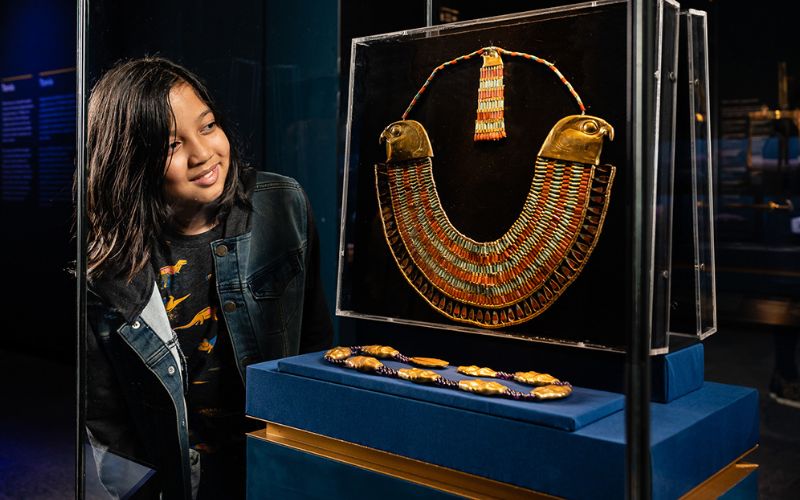
In ancient Egyptian society, jewelry served purposes that went far beyond personal adornment. It functioned as currency, religious offering, protective talisman, and marker of social hierarchy simultaneously. The Egyptians believed that certain materials held inherent magical properties: gold was the flesh of the gods, silver was their bones, and lapis lazuli mirrored the deep blue of the heavens. To wear these materials was to commune with the divine and to invite divine protection into one’s daily life.
Both men and women wore jewelry across all levels of society. Egyptian ancient pharaohs draped themselves in elaborate pectorals, broad collars, and arm cuffs to signify their divine status as living gods on earth. Priests wore specific amulets during rituals. Soldiers received a golden decoration as military honors. Even the dead were adorned with funerary jewelry crafted specifically to protect the soul during its journey through the afterlife, a practice documented in detail within the Book of the Dead.
This profoundly spiritual relationship between body ornament and cosmic meaning is what separates ancient Egyptian jewelry from the decorative traditions of most other civilizations of its era. Understanding this context is essential to appreciating why these objects have retained such fascination for thousands of years.
The Most Iconic Symbols in Ancient Egyptian Jewelry
The visual vocabulary of ancient Egyptian jewelry was rich with symbols, each carrying precise theological and magical significance. Three symbols in particular stand out for their widespread use and enduring recognition: the ankh, the scarab beetle, and the Eye of Horus. Together, these three forms appear on thousands of surviving artifacts, from royal treasures to modest clay amulets.
Ancient Egyptian Jewelry Ankh
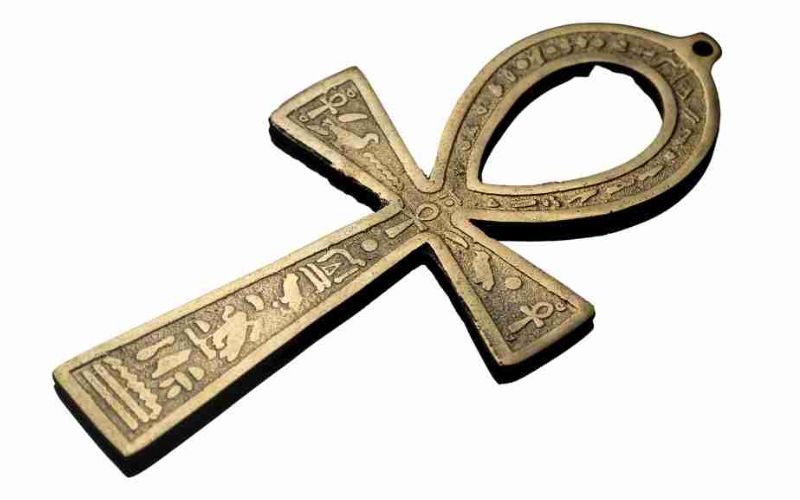
No symbol is more synonymous with ancient Egypt than the ankh. Combining a loop atop a cross, the ankh represented the breath of life and the promise of eternal existence beyond death. Gods are depicted throughout temple art holding an ankh to the nostrils of pharaohs, literally breathing divine life into their earthly ruler. As a piece of ancient Egyptian jewelry, the ankh appeared in nearly every medium: hammered in solid gold for royal pendants, inlaid with turquoise and carnelian for priestly amulets, and cast in faience for burial offerings.
The enduring power of the ankh as a jewelry motif has carried forward into the modern era, making ancient Egyptian jewelry ankh pieces among the most popular categories for collectors and contemporary designers drawing inspiration from Nile Valley culture. Its simplicity of form combined with its profound spiritual weight gives the ankh an accessibility that few ancient symbols can match.
Ancient Egyptian Scarab Jewelry
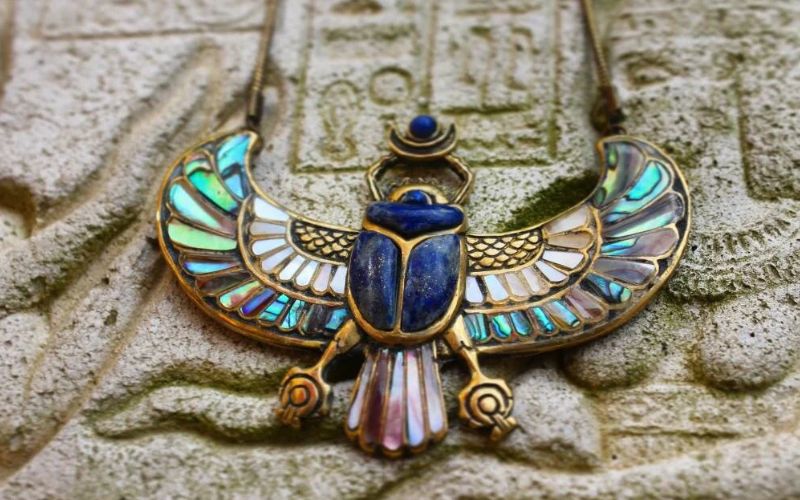
The scarab beetle, known in ancient Egypt as the khepri, was one of the most potent symbols and amulets in the entire religious system. Observed rolling balls of dung across the desert sands, the scarab beetle was seen as a living embodiment of the sun god pushing the solar disc across the sky each day. This association with solar renewal made the scarab a supreme symbol of rebirth, regeneration, and the triumph of life over death.
Ancient Egyptian scarab jewelry takes many forms. Heart scarabs were carved from green stone and placed within the wrappings of mummies to prevent the heart from testifying against the deceased during the judgment of the soul. Scarab rings were pressed into clay or wax as personal seals, their flat undersides carved with the owner’s name or a protective formula. Winged scarab pectorals, created for royal burials, were masterpieces of goldsmithing, combining gold cloisonné work with inlaid carnelian, lapis lazuli, and turquoise.
The tomb of Tutankhamun alone contained hundreds of scarab amulets, underscoring just how central ancient Egyptian scarab jewelry was to royal funerary practice. Today, scarab motifs remain among the most immediately recognisable elements of Egyptian aesthetic heritage.
The Eye of Horus
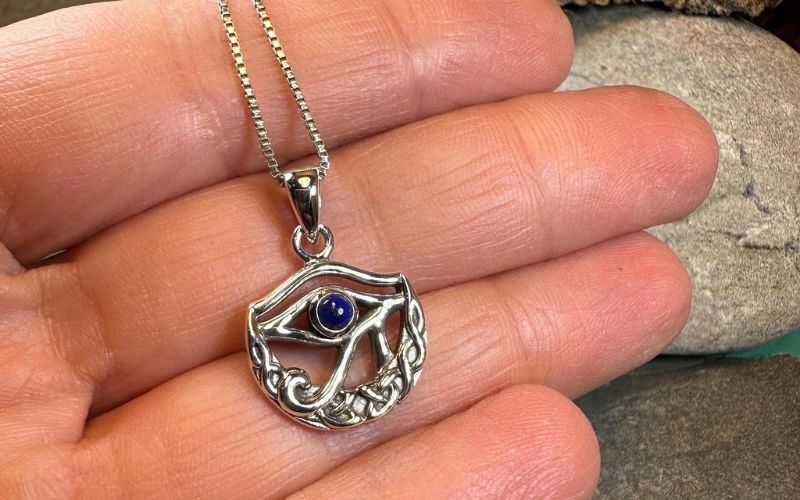
Known also as the Wedjat, the Eye of Horus represented protection, royal power, and good health. Painted and carved on thousands of amulets and pectorals, it was believed to deflect evil forces and ensure the wellbeing of the wearer both in life and in death. Gold and faience versions of the Wedjat were found in virtually every significant Egyptian burial across all periods of the civilization.
The Djed Pillar
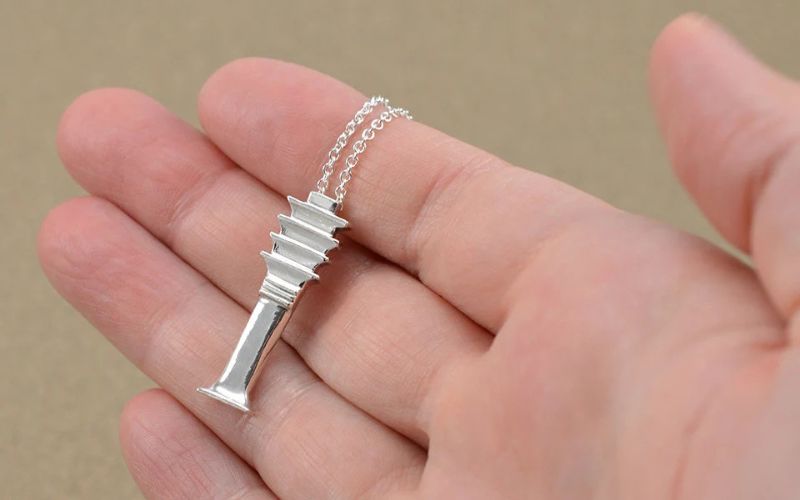
Associated with Osiris and representing stability and endurance, the djed pillar was commonly set in gold and worn as a pendant or incorporated into broad collars. It was especially prevalent in funerary contexts, where its promise of permanence offered comfort and protection to the soul navigating the dangers of the afterlife.
Gold, Gems, and Faience: The Materials of Divine Ornament
The materials used in ancient Egyptian jewelry were chosen as much for their symbolic meaning as for their visual beauty. Egyptian goldsmiths worked with extraordinary technical skill, developing techniques of cloisonné inlay, granulation, filigree, and repoussé that would not be surpassed in the ancient world for centuries. Their workshops, documented in tomb paintings, show craftsmen smelting, hammering, polishing, and assembling pieces with a precision that astonishes modern jewelers.
Gold, known in Egyptian as nebu, was the premier material of royal and divine adornment. Associated with the eternal, unchanging nature of the gods, gold was mined from deposits in Nubia and the Eastern Desert and worked into everything from funeral masks to earrings to the gilded tips of obelisks. Silver, rarer in Egypt than gold for much of the civilization’s history, was valued even more highly in early periods and associated with the bones of the gods and the light of the moon.
Lapis lazuli, imported at great expense from the mines of Afghanistan via trade routes running through the Near East, was prized for its deep celestial blue, the color of the night sky and the primordial waters from which creation emerged. Carnelian, a deep orange-red stone, was associated with the blood of Isis and believed to carry protective properties. Turquoise, mined in the Sinai Peninsula, was linked to the goddess Hathor and to concepts of joy, fertility, and protection during travel.
Faience deserves particular mention because it was the most widely used material in ancient Egyptian jewelry production and yet remains underappreciated compared to gold and precious stones. A sintered quartz compound coated in a glaze of brilliant blue or green, faience was described by the Egyptians themselves as a magical material that caught and reflected divine light. It was affordable enough to be produced in vast quantities for use across all social classes, democratising the wearing of protective amulets in a way that gold and lapis lazuli never could.
The broad collar, known as the wesekh, is perhaps the single most recognisable form of ancient Egyptian jewelry. Composed of multiple strands of beads arranged in concentric semicircles and terminating in falcon head clasps, the wesekh was worn by gods, pharaohs, nobles, and commoners alike. The design appeared as early as the Old Kingdom and remained fashionable for over two thousand years, a testament to the enduring aesthetic authority of Egyptian jewelry ancient in origin but perpetually relevant.
Ancient Egyptian Karnak Jewelry
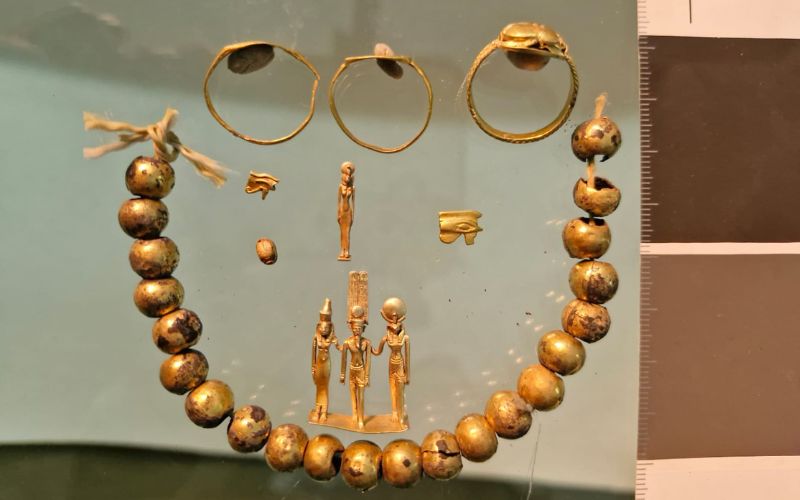
The temple complex at Karnak, located near modern Luxor on the east bank of the Nile, was the greatest religious center in the ancient world. Dedicated primarily to Amun, king of the gods, Karnak was expanded and embellished by pharaoh after pharaoh across nearly two thousand years of construction. Within its precincts, priests performed daily rituals that included the adornment of divine statues with some of the most magnificent jewelry ever created in the ancient world, and it is from this context that the tradition of ancient Egyptian Karnak jewelry emerges.
Temple inventories preserved on papyrus and carved into walls reveal the staggering quantity and quality of jewelry held by Karnak’s treasury. Divine statues were clothed in fine linen and adorned with golden pectorals, electrum collars, lapis lazuli pendants, and carnelian amulets. During festival processions, the portable barque shrine of Amun was itself encrusted with gold and jeweled decoration, carried on the shoulders of priests through the avenue of ram-headed sphinxes that once connected Karnak to the Luxor temple complex.
The jewelry associated with Karnak was not merely decorative but deeply ritual in function. Each piece placed upon a divine statue was an act of piety, an offering of beauty to a god who was believed to truly inhabit the image before which worshippers prostrated themselves. Priests who served at Karnak wore their own distinctive jewelry of office, including pectoral amulets bearing the image of Amun and broad collars that identified their rank and function within the temple hierarchy.
Today, the Egyptian Museum in Cairo and the Luxor Museum hold extensive collections of ancient Egyptian Karnak jewelry recovered from temple caches, royal tombs in the Valley of the Kings, and the remains of the workers’ village at Deir el-Medina. These pieces allow modern visitors to appreciate the technical mastery and symbolic depth of Theban goldsmithing at its height, during the New Kingdom period when Egypt’s imperial power and artistic ambition reached their peak.
Egyptian Jewelry Ancient Through Every Dynasty
To speak of Egyptian ancient jewelry as a single unified tradition risks obscuring the remarkable variation and evolution that occurred across more than three thousand years of continuous civilisation. Jewelry styles shifted significantly between the Old Kingdom, Middle Kingdom, New Kingdom, and Late Period, reflecting changes in theology, trade connections, royal patronage, and foreign influence.
Old Kingdom (c. 2686–2181 BCE)
The earliest periods of Egyptian jewelry production were characterised by relative simplicity compared to later eras. Broad collars of faience and stone beads, simple cylinder seals, and gold diadems represent the core of Old Kingdom adornment. The pyramids of Giza were built during this era, and though their contents were robbed in antiquity, surviving fragments suggest jewelry of considerable sophistication already present in the funerary equipment of the elite.
Middle Kingdom (c. 2055–1650 BCE)
The Middle Kingdom is widely considered a golden age of Egyptian jewelry craftsmanship. Tomb treasures from this period, including the spectacular jewelry of the royal women buried at Dahshur and Lahun, reveal goldsmiths working at the very height of their technical ability. Cloisonné inlay work using carnelian, turquoise, lapis lazuli, and garnet was brought to a standard of precision and elegance rarely equalled in the ancient world. Pectorals depicting the cartouche of the reigning pharaoh, girdles of gold and carnelian, and delicate diadems with golden rosettes characterise the Middle Kingdom aesthetic.
New Kingdom (c. 1550–1070 BCE)
The New Kingdom represents the era of greatest imperial power and artistic ambition in Egyptian history, and its jewelry reflects this confidence fully. The discovery of Tutankhamun’s tomb in 1922 gave the modern world its most complete picture of New Kingdom royal jewelry: golden death masks, pectorals depicting the solar barque, winged scarab breastplates, golden sandals, rings bearing the royal cartouche, and hundreds of amulets of every shape and material. This is also the period most closely associated with ancient Egyptian Karnak jewelry, as pharaohs of the Eighteenth and Nineteenth Dynasties invested extraordinary resources in temple furnishings and priestly equipment.
Late Period and Ptolemaic Era (c. 664–30 BCE)
The final centuries of pharaonic Egypt saw increasing Greek and Mediterranean influence on jewelry forms, while core Egyptian symbolism remained constant. Hellenistic style met ancient Egyptian iconography in pieces that combined Greek gold granulation techniques with traditional ankh, scarab, and Eye of Horus motifs. This fusion produced some of the most visually complex jewelry of the entire tradition, appreciated today by collectors who seek Egyptian jewelry ancient in spirit but cosmopolitan in execution.
The Legacy of Ancient Egyptian Jewelry in the Modern World
The influence of ancient Egyptian jewelry on contemporary design is impossible to overstate. Every major revival of interest in Egyptology, from the Napoleonic campaigns of the early nineteenth century to the worldwide fascination triggered by the opening of Tutankhamun’s tomb in 1922, has produced a corresponding wave of Egyptian-inspired jewelry design. Art Deco design, one of the most influential aesthetic movements of the twentieth century, drew directly and extensively from Egyptian motifs: the lotus, the scarab, the Eye of Horus, and geometric forms derived from temple architecture all appear throughout the Deco jewelry canon.
Today, contemporary designers working in gold, silver, and precious stones continue to return to ancient Egyptian forms for inspiration. The ankh has become one of the most widely worn pendant forms in the world, transcending its origins to become a universal symbol of life and spiritual identity. Ancient Egyptian scarab jewelry has been reimagined in countless variations, from faithful archaeological reproductions cast in 18 karat gold with genuine gemstone inlays to modernist interpretations that retain only the essential outline of the beetle form. Ancient Egyptian Karnak jewelry, with its associations of divine grandeur and ceremonial magnificence, inspires jewelers who seek to create pieces that carry a sense of ritual weight and historical depth.
Museums worldwide, including the Egyptian Museum in Cairo, the British Museum in London, the Metropolitan Museum of Art in New York, and the Louvre in Paris, hold collections of ancient Egyptian jewelry that draw millions of visitors each year. These objects continue to communicate across the millennia with a directness and power that confirms their makers’ deepest belief: that beauty created in the service of the divine is beauty that truly does not die.
Frequently Asked Questions
What materials were most commonly used in ancient Egyptian jewelry?
Gold was the premier material for royal and elite jewelry, valued for its association with divine flesh and its resistance to tarnish. Lapis lazuli, carnelian, turquoise, and amethyst were the most prized semiprecious stones. Faience, a glazed quartz composite, was the most widely produced material across all social classes, enabling even ordinary Egyptians to own amulets and beaded jewelry.
What is the significance of ancient Egyptian jewelry ankh pieces?
The ankh symbol represents eternal life and divine breath in Egyptian theology. When worn as jewelry, the ankh was believed to connect the wearer with divine protection and the promise of life beyond death. It was one of the most frequently depicted symbols in Egyptian art and among the most commonly produced amulet forms across every period of Egyptian history.
What made ancient Egyptian scarab jewelry so significant?
The scarab beetle was associated with Khepri, the morning aspect of the sun god Ra, and symbolised solar renewal and rebirth. Ancient Egyptian scarab jewelry served multiple functions: as personal seals, as protective amulets for the living, and as funerary objects to safeguard the dead. Heart scarabs placed within mummies were among the most important pieces of funerary equipment in the entire Egyptian tradition.
Where can I see examples of ancient Egyptian Karnak jewelry today?
The finest collections of ancient Egyptian Karnak jewelry and related New Kingdom pieces are held by the Egyptian Museum in Cairo, the Luxor Museum, the British Museum in London, and the Metropolitan Museum of Art in New York. Many of these museums offer digital collections, allowing online access to detailed photographs and scholarly descriptions of individual pieces.
Did ordinary ancient Egyptians wear jewelry?
Yes, absolutely. While the most elaborate pieces in precious metals and gemstones were reserved for royalty and the elite, ordinary Egyptians wore jewelry made from faience, copper, bone, shell, and clay. Beaded necklaces, simple amulets, and ring seals were common across all social levels. The desire to wear protective symbols was universal in Egyptian culture, not restricted to the wealthy.
A Tradition That Outlived a Civilization
Ancient Egyptian jewelry is more than a collection of beautiful objects preserved in museum cases. It is a window into a civilization’s deepest beliefs about life, death, the cosmos, and the relationship between human beings and the divine. Every scarab amulet pressed into clay carries the solar theology of three thousand years. Every ankh pendant whispers a promise of eternal life. Every broad collar gleaming with carnelian and gold reflects the image of a culture that saw beauty itself as a sacred act.
The craftsmen of the Nile Valley left behind an aesthetic legacy so powerful and so coherent that it has never truly fallen out of fashion. From the Ptolemaic workshops that blended Egyptian and Greek traditions to the Art Deco ateliers of 1920s Paris to the contemporary designers who engrave scarabs onto titanium pendants for a global market, ancient Egyptian jewelry continues its unbroken conversation with the present. It speaks of permanence in a transient world, of meaning embedded in material, of the human need to adorn the body with objects that declare: we are more than flesh; we belong to something eternal.
That is why, thousands of years after the last pharaoh walked the corridors of Karnak, we are still reaching for the ankh, still threading scarabs onto chains of gold, still following the lead of those brilliant craftsmen who first learned to speak the language of eternity in stone and metal.